
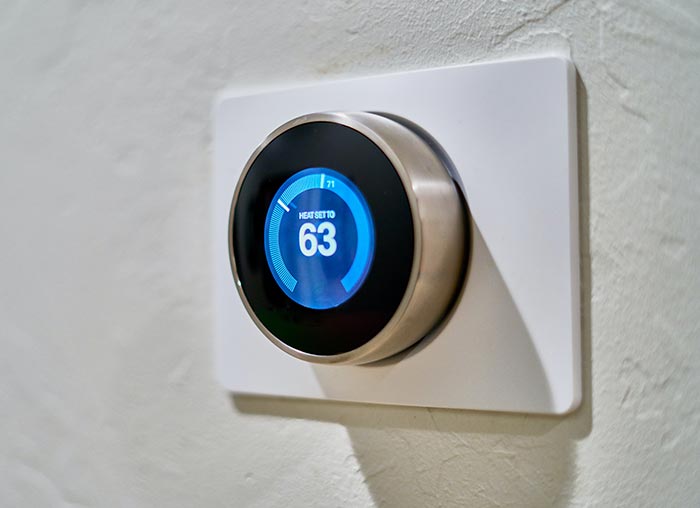
This morning you feel great! You woke up by your smart watch right at the moment you slept the lightest. It is a gray and cold winter morning. The curtains open automatically and the moment you walk into the living room the room is already at a pleasant temperature and the coffee is ready. While you’re showering, your car’s heating is turned on so you don’t have to scrap off the frost. You step into your autonomous car and she already knows where to go today. He also knows that an accident happened on the way, so she takes an alternative route. Nevertheless, you are late for your appointment at the office. No worries, because a message has already been sent to all participants of the meeting telling them that you will arrive fifteen minutes later. The entire day goes on like this. Everything talks to everything. Futuristic? Not as far as technology is concerned. Technically speaking this is already achievable. We call it Internet of Things or IoT.
IoT Components
IoT consists of 4 components namely hardware, data, software and connectivity. All these components have gone through revolutionary developments in recent years. Hardware has become significantly faster and cheaper. Due to mass production and technological developments, sensors are being made for under one euro and are expected to become much cheaper. Data, also known as the blood of the IoT, is collected and analyzed by artificial intelligence (AI). Not only can we monitor the data and recognize patterns, we can also predict what is coming next. Software has had a major breakthrough in recent years. Through smart software and Machine Learning, we now let things communicate with each other and use AI and complex algorithms to analyze the mass data to recognize patterns. And last but not least, we can now connect everything everywhere to each other and to the Internet. We have a vast network infrastructure and protocols at our disposal to communicate anything with everything and everywhere; bluetooth, Zigbee, Z-wave, 6LowPAN, Thread, WiFI, NFC, mobile data networks, etc. are just examples of these protocols.
IoT Impact
It all sounds fun, of course, but why should we even bother? In 2025, according to a study by McKinsey (June 2015), the annual impact of IoT is $ 11 trillion. This implicates a lot of changes at homes, factories, cities, healthcare, work environment, transport, and more. The two driving forces behind the drastic changes are efficiency and cost savings. As such, we will be doing business differently in the coming years. We will produce differently, market and sell differently, and offer different innovative services. And this is where the major business software vendors like SAP come into the picture.
SAP & IoT
SAP like other major software vendors has signaled this market trend and has invested heavily in it over the past few years. SAP Leonardo is the new SAP platform for IoT. SAP already had the main ingredients of IoT technology in its portfolio: Big Data, Analytics, Cloud Platform, etc. And now SAP has built up a comprehensive portfolio with all necessary ingredients, including Machine Learning, Design Thinking and Blockchain. With SAP Leonardo, we can not only supplement and automate current processes, but also develop solutions for new alternative business models. Or as SAP calls it “digital transformation”. Under the SAP Leonardo platform, SAP also offers turnkey solutions for Connected Products, Connected Assets, Connected Fleet, Connected Infrastructure, Connected Markets and Connected People. HANA Cloud Platform and SAP Analytics will play a major role in this and will offer SAP a major advantage over its competitors.
The impact of IoT on our lives will continue to grow in the coming years. We may be able to ignore IoT, but we won’t be able to avoid the impact. Or as writer and philosopher Ayn Rand puts it nicely: “You can avoid reality, but you cannot avoid the consequences of avoiding reality.”
Everything is very open with a precise explanation of the challenges. It was really informative. Your website is very helpful. Many thanks for sharing!